Foundation drawn by hand
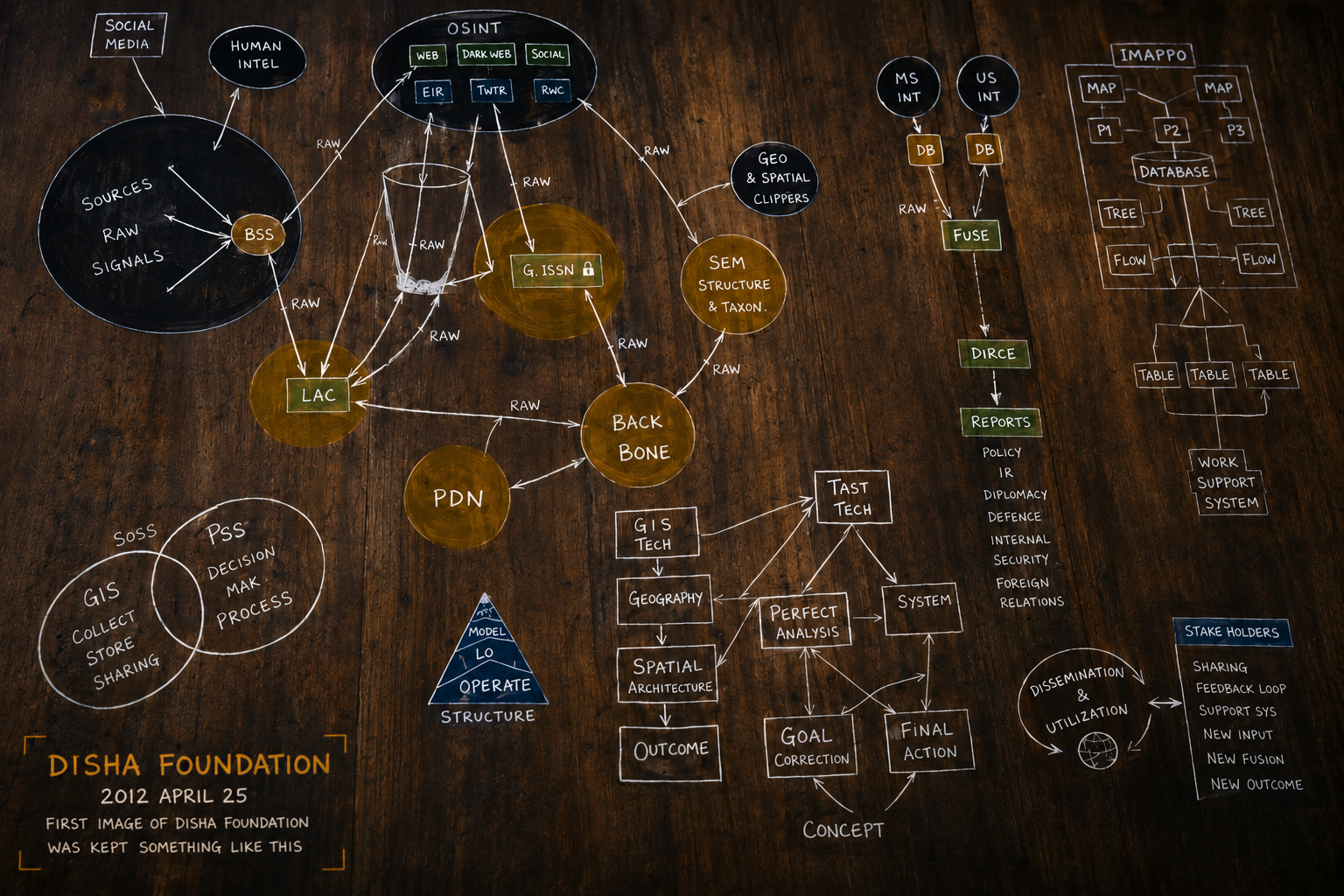
The first DISHA architecture sketch is dated 25 April 2012. It establishes the visual grammar of sources, signals, analysis, policy, reporting, and stakeholder feedback.
DISHA Intelligence Architecture
DISHA is presented here as a premium public-interest intelligence architecture: conceived in 2012, built as a cyber-evidence and public-record system, and governed by a defensive, policy-gated doctrine.

The foundation | 25 April 2012
Long before data theft, digital arrest, and public cyber-risk entered daily headlines, DISHA began as a hand-drawn architecture for evidence-first defence of the citizen.
The foundation image is not decoration. It is the base record: sources, raw signals, OSINT, GIS, analysis, policy, reports, stakeholders, and public memory arranged as one defensive intelligence system.
What DISHA can do
DISHA is not a generic dashboard. It is designed to study intent, classify risk, support defensive action, preserve records, and make accountability readable for researchers, journalists, institutions, and citizens.
Its value is not only technical. DISHA shows how constitutional accountability, cyber forensics, public administration, public records, and citizen safety can be joined into one disciplined intelligence architecture.
Signed telemetry, public records, OSINT, GIS context, and documentary inputs.
Intent, origin, risk, pattern, and strategic threat posture.
Block, isolate, quarantine, revoke, rotate, and recover under policy.
Hash-chained records, evidence trails, reports, and public memory.
Build line
The page now gives the reader the missing detail: origin, build, doctrine, source record, and public-interest use.
The first DISHA architecture sketch is dated 25 April 2012. It establishes the visual grammar of sources, signals, analysis, policy, reporting, and stakeholder feedback.
The architecture moves from concept into an evidence-and-monitoring practice, focused on citizen protection, defensive intelligence, and record preservation.
DISHA adds reasoning, telemetry, OSINT, spatial context, risk analysis, and tamper-evident documentation discipline.
The architecture is described through policy, source trails, research records, and court-related public documentation.
Six layers
Status labels are deliberate. Operational means active capability or working system logic; policy-gated means the layer is controlled by doctrine and staged for safe integration.
The cognitive core for reasoning, planning, decisioning, anomaly detection, and risk scoring across the system.
Field signal and telemetry units that collect signed information from digital environments and pass it into the intelligence core.
Threat analysis and pattern recognition that turns raw signals into intelligence about origin, intent, and risk.
Strategic threat assessment - the Vyuha defence framework, which maps classical formations to defensive cyber modes through declarative, policy-gated rules and an analyzer. Orchestration is staged for integration with the control plane.
Forensic preservation, source records, hashes, time-bounded evidence trails, and citation discipline for later review.
A living archive of violations, submissions, evidence, references, and public-interest documentation.
Source code
The page presents source-code access as part of the evidence record, while keeping the system framed as a defensive public-interest architecture governed by policy, audit, and restraint.
DISHA may defend, isolate, preserve, and recover. It is not presented as an offensive retaliation system.
High-risk orchestration is staged through written rules, analyzers, and control-plane discipline.
Evidence flow
The system is presented as an evidence engine: signal comes in, intelligence is formed, defensive action is policy-gated, and the record is preserved.
Signed signal, OSINT, GIS, public record, and contextual data enter the system.
The brain studies intent, anomaly, origin, risk, and relevance to citizen harm.
Policy-gated defensive modes block, isolate, quarantine, revoke, rotate, and recover.
Records are preserved with source context, report discipline, and public memory.
Proof and record
DISHA is introduced through dates, documents, source trails, research claims, and public records so readers can distinguish architecture, implementation, and legal context.
First architecture sketch dated 25 April 2012, presented as the base record for the system.
The concept moves from hand-drawn foundation into a continuing evidence-and-monitoring practice.
Research and evidence references connect to wider constitutional and cyber-governance documentation.
Closing exhibit
The same hand-made foundation image is kept again at the end so the reader leaves with the record, not only the modern product framing.